

SEPA Instant Payments are often described as a straightforward improvement on traditional bank transfers: faster execution, immediate confirmation, and availability at any time of day. For European merchants, however, the reality is more layered. While the scheme promises speed, real-world usability depends on bank participation, transaction limits, and the way payment service providers implement the rail.
Before relying on SEPA Instant for customer-facing payments, merchants need a practical understanding of where it actually works today and how limits affect real transaction flows.
- What Are SEPA Instant Payments?
- Where SEPA Instant Payments Are Available Today
- How Merchants Can Use SEPA Instant Payments
- Transaction Limits Under SEPA Instant Payments
- Operational Considerations for Merchants
- Key Limitations Merchants Should Be Aware Of
- What Merchants Should Understand Before Relying on SEPA Instant
- Conclusion
- FAQs
What Are SEPA Instant Payments?
SEPA Instant Payments operate under the SEPA Instant Credit Transfer (SCT Inst) scheme. This framework allows euro-denominated credit transfers to be completed within seconds, rather than hours or days.
The scheme is governed by the European Payments Council, which defines the technical standards, processing timelines, and operating rules. Importantly, SCT Inst is a scheme, not a product. Banks and PSPs choose whether to participate and how extensively they support it.
This already sets it apart from standard SEPA Credit Transfers, which are processed in batches, subject to cut-off times, and typically settle on the next business day. SEPA Instant removes these timing delays, but it does not remove institutional controls or risk considerations.
What “Instant” Means in Practice
In practice, “instant” refers to execution speed and confirmation. When supported by both banks, a payment is processed within seconds and confirmed immediately, regardless of the time or day.
What it does not imply is universal availability or unrestricted usage. Instant processing does not bypass:
- Bank participation requirements
- Transaction value limits
- PSP settlement cycles
For merchants, this distinction is critical when setting customer expectations and designing payment flows.
Where SEPA Instant Payments Are Available Today
At scheme level, SEPA Instant is available across the entire SEPA area, including the EU, the EEA, and a small number of additional participating territories. On paper, this gives it pan-European reach.
In practice, availability is shaped by bank participation rather than geography alone.
Bank Participation and Country Coverage
Participation in SCT Inst is optional. Banks can support inbound payments, outbound payments, or both, and not all institutions choose full participation. As a result, coverage varies significantly by country and even by bank within the same market.
Western European markets such as the Netherlands, Spain, France, and Italy generally show broader adoption, while other regions still display fragmented or partial support. Even in high-adoption countries, merchants cannot assume that every customer’s bank supports instant transfers.
For a SEPA Instant payment to work, both the sending bank and the receiving bank or PSP must support the scheme. If either side does not, the transaction must fall back to a standard SEPA transfer.
How Merchants Can Use SEPA Instant Payments
Common Merchant Use Cases
SEPA Instant is most effective in scenarios where immediate confirmation improves the customer experience. Common examples include:
Account funding and wallet top-ups
Services requiring immediate access after payment
Select payout or refund scenarios where speed matters
These use cases benefit from instant confirmation, but only when transaction values fall within applicable limits and customer banks support the scheme.
Practical Usage Constraints
Despite these advantages, SEPA Instant cannot be treated as a universal payment option. Not all customers are eligible, and transaction failures may occur simply because a bank does not support the scheme or applies restrictive limits.
For this reason, most merchant implementations require fallback options. Payment routing logic, PSP capabilities, and bank connectivity all play a decisive role in whether SEPA Instant can be offered reliably.
Transaction Limits Under SEPA Instant Payments
Scheme-Level Limits
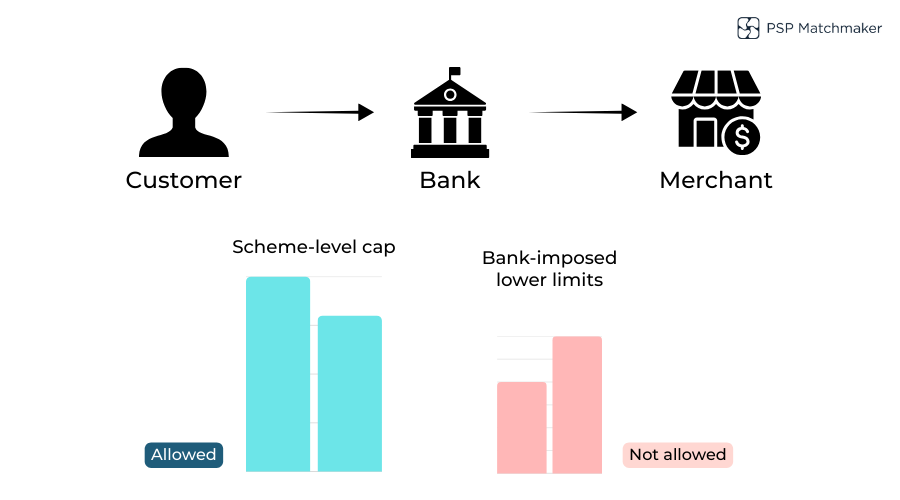
The European Payments Council defines a maximum transaction value per SEPA Instant transfer. This limit applies to individual transactions rather than daily or customer-level totals, and it represents the highest amount the scheme allows a single instant payment to carry.
While this provides a consistent ceiling, it does not reflect what merchants will necessarily see in production environments.
Bank-Imposed Limits
In reality, most banks apply lower outbound limits than the scheme maximum. These limits vary based on customer type, account history, and internal risk controls. Business accounts may face different thresholds from retail accounts, and limits can differ substantially between banks operating in the same country.
For merchants, this creates uncertainty at the point of payment. A transaction that is technically eligible under the scheme may still be rejected due to bank-level restrictions.
What Limits Mean for Merchants
Transaction limits directly affect which payments can be processed via SEPA Instant. Higher-value transactions may be excluded entirely, while others may succeed for some customers and fail for others.
This has implications for checkout design, payment method ordering, and customer messaging. Merchants that rely heavily on SEPA Instant must plan for variability rather than consistency.
Operational Considerations for Merchants
Confirmation vs Settlement
Although SEPA Instant provides immediate confirmation, settlement to the merchant’s PSP account is not always instantaneous. PSPs may apply their own processing schedules, risk reviews, or internal settlement cycles.
Merchants should therefore distinguish clearly between customer confirmation and actual fund availability when managing liquidity.
Refund Handling
SEPA Instant does not support chargebacks in the way card schemes do. Refunds are processed as new credit transfers, initiated by the merchant. This changes both operational workflows and customer expectations, particularly in dispute scenarios.
Reconciliation and Reporting
Instant confirmation simplifies payment visibility, but it does not eliminate reconciliation work. Merchants still need to align transaction data across internal systems, PSP reports, and bank statements, especially when multiple payment rails are in use.
Key Limitations Merchants Should Be Aware Of
SEPA Instant Payments come with structural constraints:
- They are not universally available across all banks
- Bank-specific limits affect transaction eligibility
- Customer experience varies by bank and PSP
- They complement, rather than replace, other payment methods
Ignoring these limitations often leads to inconsistent payment experiences.
What Merchants Should Understand Before Relying on SEPA Instant
SEPA Instant Payments are best understood as an enabling capability. Their effectiveness depends on bank participation, transaction limits, and the quality of PSP infrastructure supporting them. Merchants that assume uniform availability or consistent limits often encounter friction once payments go live.
Conclusion
SEPA Instant Payments offer genuine benefits in speed and availability, but their real-world value for merchants depends on how and where they are implemented. Bank participation, transaction limits, and operational handling all shape whether instant payments deliver on their promise.
For European merchants, the key is not whether SEPA Instant exists, but whether it works consistently for their customer base. Understanding these nuances before relying on the rail can prevent payment failures, customer frustration, and operational surprises later on.
FAQs
1. Are SEPA Instant Payments available in all European countries?
SEPA Instant Payments are available at scheme level across the SEPA area, but real availability depends on bank participation. Not all banks in every country support SEPA Instant, and some only offer partial functionality.
2. Do all banks support SEPA Instant Credit Transfers?
No. Participation in SEPA Instant is optional. Banks may support inbound transfers, outbound transfers, or neither. For a payment to succeed, both the payer’s bank and the recipient’s bank or PSP must support SEPA Instant.
3. What is the difference between SEPA Instant and standard SEPA Credit Transfers?
The main difference is speed. SEPA Instant payments are processed within seconds and are available 24/7, while standard SEPA Credit Transfers are typically processed in batches and may take one or more business days to complete.
4. Are SEPA Instant Payments really processed instantly for merchants?
Payments are confirmed instantly when successful, but this does not always mean funds are immediately available in the merchant’s account. Settlement timing depends on the PSP’s internal processes and risk controls.
5. What transaction limits apply to SEPA Instant Payments?
There is a scheme-level maximum per transaction set by the European Payments Council. However, most banks apply lower limits based on customer type, account profile, and internal risk policies.
6. Can merchants accept high-value transactions using SEPA Instant?
SEPA Instant is generally not suitable for high-value transactions. Bank-imposed limits often prevent larger payments from being processed, making standard SEPA transfers or other payment methods more appropriate.
7. What happens if a customer’s bank does not support SEPA Instant?
If either the customer’s bank or the merchant’s receiving bank does not support SEPA Instant, the payment cannot be completed instantly. Merchants usually need to offer a fallback, such as a standard SEPA Credit Transfer.
8. Can SEPA Instant Payments be reversed or charged back?
No. SEPA Instant Payments do not support chargebacks in the same way card payments do. Refunds must be initiated by the merchant as a new credit transfer to the customer.
9. Is SEPA Instant suitable as a primary payment method for merchants?
SEPA Instant works best as a complementary payment option rather than a primary one. Variations in bank support and transaction limits make it unreliable as a sole payment method for most merchants.
10. What should merchants consider before enabling SEPA Instant Payments?
Merchants should assess bank coverage across their customer base, understand applicable transaction limits, and ensure their PSP can support routing, fallback options, and reconciliation. Without this preparation, customer experience may be inconsistent.



Leave a Reply