

Europe’s payment environment is fundamentally regulation-led. The way payments are accepted, authenticated, processed, and monitored is shaped less by market preference and more by regulatory obligation. For merchants, this means that payment operations are never just a technical setup; they are a reflection of compliance requirements imposed on PSPs and banks. This blog explains which EU payment regulations matter most to merchants today and how they practically change day-to-day payment operations.
How EU Payment Regulation Is Applied in Practice
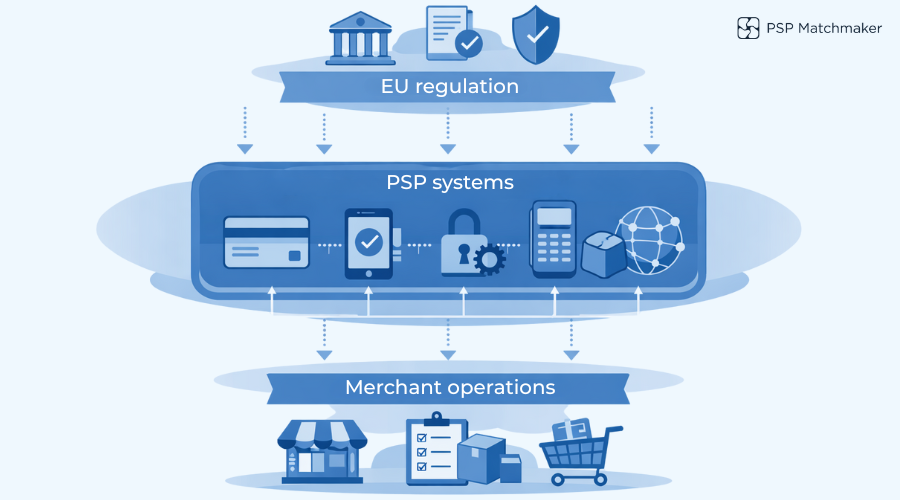
Most EU payment regulations are written at European level, but enforcement happens locally. National regulators supervise banks and PSPs, interpreting EU rules through domestic frameworks and supervisory priorities.
As a result, merchants often experience variation not because the regulation is different, but because:
Local regulators apply different levels of scrutiny
PSPs interpret and implement requirements differently
In practice, merchants feel regulation through the PSPs they work with. The same regulatory obligation can lead to different onboarding processes, payment flows, or monitoring requirements depending on how a PSP has operationalised it.
PSD2 and Strong Customer Authentication (SCA)
The Payment Services Directive 2 governs payment services across the EU and is one of the most visible regulations affecting merchants. One of its most significant operational components is Strong Customer Authentication (SCA), which requires additional customer verification for many electronic payments.
For merchants, SCA changes payment operations in several ways:
- Some transactions require extra authentication steps at checkout
- Approval outcomes increasingly depend on issuer and PSP decisions
- Exemptions (such as low-value or trusted beneficiaries) become critical
Although PSD2 sets the framework, SCA is not applied uniformly. Different PSPs support different exemption strategies, and issuers ultimately decide whether authentication is required. This is why merchants often see varying approval rates and customer experiences across payment providers.
Anti-Money Laundering Directives (AMLD) and Merchant Reviews
The EU’s Anti-Money Laundering Directives place ongoing obligations on PSPs to prevent financial crime. These rules require PSPs to verify merchant identity (KYB), assess ownership and control structures, and monitor transactions after onboarding.
For merchants, AMLD requirements translate into:
- Deeper documentation requests during onboarding
- Periodic reviews after approval
- Expectations around transaction transparency and reporting
These obligations do not end once a merchant goes live. PSPs must continuously reassess risk, which is why merchants may be asked for updated information months or years after onboarding. Operationally, this makes compliance an ongoing relationship rather than a one-time hurdle.
SEPA Regulation and Bank Transfer Payments
SEPA regulation standardises euro-denominated bank transfers across Europe, covering both SEPA Credit Transfers and SEPA Instant Payments. The goal is interoperability, but merchant experience still depends heavily on bank participation.
Operationally, SEPA affects merchants by:
Enforcing standardised payment formats and references
Enabling cross-border euro transfers under common rules
Introducing differences in speed and availability between standard and instant payments
While SEPA provides a shared framework, not all banks support the same capabilities, particularly for instant payments. As a result, merchants must design payment flows that account for fallback options and inconsistent customer eligibility.
Data Protection Rules (GDPR) in Payment Operations
Payment processing inevitably involves personal data, which brings it under the scope of the General Data Protection Regulation. GDPR influences how merchants collect, store, and share payment-related information.
Merchants must ensure that payment data handling aligns with GDPR principles, particularly when working with multiple PSPs, fraud tools, or third-party service providers.
Upcoming Regulatory Changes Affecting Payments
EU payment regulation continues to evolve. Current focus areas include fraud prevention, wider availability of instant payments, and tighter supervision of PSP resilience.
Typically, regulatory changes are absorbed first by PSPs and banks, who update their systems, controls, and processes. Merchants then experience these changes indirectly through:
- Altered onboarding requirements
- Modified checkout or authentication flows
- New reporting or data expectations
This lag between regulatory change and merchant impact often makes regulation feel reactive rather than predictable.
How EU Payment Regulations Change Day-to-Day Merchant Operations
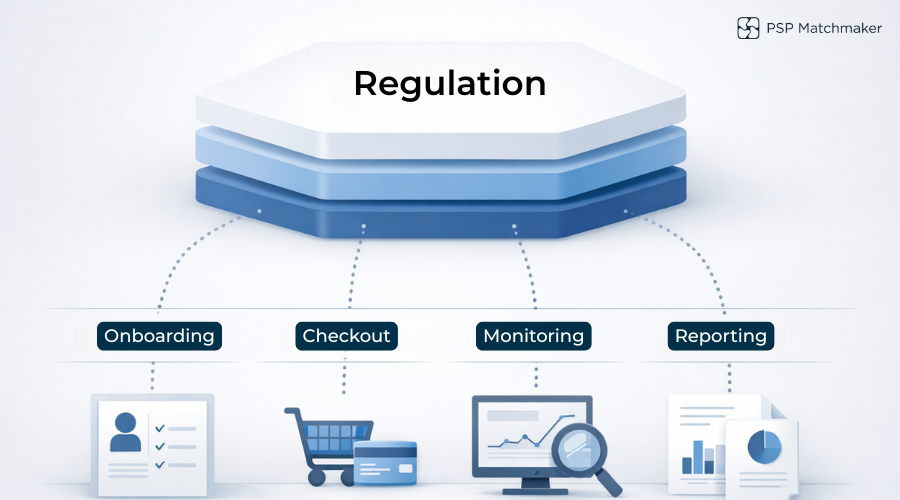
Taken together, EU payment regulations shape everyday merchant operations in tangible ways. They influence which payment methods are available, how authentication flows are designed, and how transactions are monitored after approval.
- Payment method availability and usage limits
- Checkout design and customer friction
- Onboarding timelines and documentation depth
- Transaction monitoring and reporting obligations
- How refunds and disputes are handled
Many of these impacts are indirect, flowing through PSP systems rather than merchant policy decisions. This is why merchants often feel constrained by provider capabilities rather than by regulation itself.
What Merchants Should Understand About EU Payment Regulation
EU payment regulation is not just a compliance layer; it defines how payments function. PSP capabilities, approval rates, and operational flexibility are all shaped by regulatory obligations.
Crucially, different PSPs may implement the same regulation in different ways. For merchants, this means that choosing the right PSP is as important as understanding the regulation itself. Operational outcomes depend on how well a provider’s implementation aligns with the merchant’s business model and risk profile.
Conclusion
EU payment regulations play a central role in shaping how merchants accept and manage payments. While the rules are set at European level, their real impact is felt through local enforcement and PSP implementation. Merchants that understand how regulation translates into operational constraints are better equipped to design resilient payment setups and avoid unexpected friction as rules continue to evolve.
FAQs
1. Which EU payment regulations affect merchants the most today?
The most impactful regulations for merchants today are PSD2 (including Strong Customer Authentication), Anti-Money Laundering Directives (AMLD), SEPA regulations for bank transfers, and GDPR for payment-related data handling.
2. Do EU payment regulations apply directly to merchants or only to PSPs?
Most EU payment regulations apply directly to PSPs and banks, but merchants experience their impact indirectly. PSP compliance obligations shape onboarding requirements, checkout flows, monitoring, and reporting expectations for merchants.
3. Why does the same regulation feel different across countries?
Although regulations are set at EU level, enforcement happens locally. National regulators supervise PSPs differently, and providers interpret requirements based on local expectations, leading to variation across markets.
4. How does PSD2 affect merchant checkout experiences?
PSD2 introduces Strong Customer Authentication, which can add extra steps at checkout for some transactions. Whether SCA is applied depends on exemptions, PSP support, and issuer decisions, resulting in different approval outcomes.
5. Why are merchants asked for more documentation due to AML rules?
Anti-Money Laundering rules require PSPs to verify merchant identity, ownership, and business activity. This leads to deeper onboarding checks, periodic reviews, and ongoing transaction monitoring after approval.
6. How does SEPA regulation influence bank transfer payments?
SEPA standardises euro bank transfers across Europe, but speed and usability still depend on bank participation. Merchants often need fallback options because not all banks support instant transfers equally.
7. What role does GDPR play in payment operations?
GDPR affects how payment-related personal data is collected, stored, and shared. Merchants must follow data minimisation principles, manage consent carefully, and ensure compliant data retention practices.
8. Do regulatory changes usually affect merchants immediately?
No. Regulatory changes are typically implemented first by PSPs and banks. Merchants experience the impact later through changes to onboarding processes, payment flows, or reporting requirements.
9. Can different PSPs implement the same regulation differently?
Yes, PSPs have different risk appetites, technical capabilities, and compliance interpretations. As a result, merchants may see different operational outcomes even under the same regulation.
10. How should merchants approach EU payment regulation strategically?
Merchants should focus on understanding how regulation affects payment operations in practice and choose PSPs whose regulatory implementation aligns with their business model, markets, and risk tolerance.



Leave a Reply